Left: The Well of Loneliness, written by Radclyffe Hall. (1928, Jonathan Cape). Predates the lesbian pulp phenomenon. Credit. Middle: Women’s Barracks, by Tereska Torres. Often known as the first lesbian pulp.(1950, Fawcett Books). Credit. Right: Spring Fire, by Vin Parker. A pro-lesbian pulp novel. (1952, Gold Medal Books). Credit.
Left: We Walk Alone: Through Lesbo’s Lonely Groves, by Ann Aldrich. (1955, Fawcett Gold Medal). A journalistic pulp. Credit. Middle: This Bed We Made by Artemis Smith. (1961, Monarch). A virile adventure. Note the man on the cover, a convention that was popular in virile adventures. Credit. Right: The Third Way by Sheldon Lord. (1962, Beacon Books). A virile adventure. Credit.
Left: Twilight Girl by Della Martin. (1961, Beacon Books). A pro-lesbian pulp. Note the tagline – “Lorraine was “different – but was she bad?” Credit. Middle: Whisper Their Love by Valerie Taylor. A pro-lesbian pulp. (1957, Fawcett).Credit. Right: The Price of Salt, by Patricia Highsmith (published under the pseudonym Claire Morgan). (1952, Coward-McCann). This book gained an immediate and lasting cult following, and was made into the 2015 film Carol starring Cate Blanchett and Rooney Mara. Credit.
Left: Beebo Brinker, by Ann Bannon. (1962, Gold Medal Books. This edition, 2001). Bannon wrote the famous Beebo Brinker Chronicles, which are comprised of six books published between 1957 and 1962. Credit. Middle: Journey to a Woman, by Ann Bannon. (1960, Gold Medal Books. This edition, 2001).Ann Bannon (Born Ann Weldy) was 22 years old and married when she published her first book . Credit. Right: I Am a Woman, by Ann Bannon. (1959, Gold Medal Books This edition, 2001). The series was republished in 2001 and adapted as an Off-Broadway production. Credit.
For more on lesbian pulp novels, see Yvonne Keller’s 2005 article “”Was It Right To Love Her Brother’s Wife So Passionately?”: Lesbian Pulp Novels and U.S. Lesbian Identity, 1950-1965,” and Suzanna Danuta Walters’ 1989 article “As Her Hand Crept Slowly up Her Thigh: Ann Bannon and the Politics of Pulp.” Find in Works Cited.
For more images of lesbian pulp novel covers, check out this great Twitter account, Lesbian Pulp Bot.
In 1973, Alix Dobkin released Lavender Jane Loves Women, now known as the first “out” lesbian album ever released. In March of 2018, 45 years later, Hayley Kiyoko released her debut album Expectations, the first-ever mainstream lesbian pop album. Kiyoko, an LA native and former Disney Channel star, is known by her fans as “Lesbian Jesus,” a nickname which illustrates the reverences with which fans treat her and her music. The album peaked at #12 on the Billboard Hot 200 and received mixed to positive reviews from critics, but more importantly, it is an album that is beloved by fans. (If Hayley Kiyoko is Lesbian Jesus, then it only follows that Expectations is the lesbian bible).
While the connection between Alix Dobkin and Hayley Kiyoko that I opened with may seem tenuous, what I am attempting to do here is draw a line (albeit, not a straight one) between the origins of lesbian music in the 1970s and Kiyoko’s ascension as Lesbian Jesus in 2019. In Jodie Taylor’s (2012) chapter about lesbian music in the mainstream, she provides a brief overview of lesbian music from the 1970s to the 2000s. Taylor writes that “womyn’s music” in the 1970s “was a reaction against the heteropatriarchy and the sexist power politics that dominated the rock and pop styles championed by the mainstream music industry of the time” (41). Thus, both the content and style of lesbian music was posited as an alternative to the mainstream, heteronormative music industry. Dobkin’s Lavender Jane LovesWomen was in this sense both political and polemical. In Dobkin’s own words, the album contained “an express desire for ‘lesbians to have tangible musical proof of their existence’” (Taylor, 41). During this era, lesbian feminist music was explicitly alternative, and there was no desire among these musicians to enter the mainstream.
In the 1980s and 1990s, more mainstream lesbian artists like Tracy Chapman and k.d. lang saw “mainstreaming” as a subversive action (Taylor 42). It is important to note, however, that many of these artists, including lesbian icon Melissa Etheridge, were not “out” during the early years of their careers. In 1993, k.d. lang and Cindy Crawford’s famous Vanity Fair cover is said to have marked the beginning of the concept of “lesbian chic” and the mainstream media’s fascination with (certain types) of lesbians. This fascination, which at times bordered on fetishization, continued through the 2000s, culminating in events like the Maddona/Britney Spears kiss at the 2003 VMAs, the Russian band t.A.T.u’s faux lesbian aesthetic, and Katy Perry’s straight-girl-experimenting-at-a-party anthem “I Kissed A Girl” in 2008.
To put it simply, lesbian culture and lesbian media have always had a complicated relationship with the mainstream. As Taylor puts it, “given the marginalization of queers within the mainstream, a phrase like ‘mainstream lesbian music’ is likely to be read as a contradiction in terms” (39). This is why the release of Kiyoko’s Expectations, an album that truly is one of the first of its kind, is such a significant moment in the history of music more broadly, and in the history of lesbian music specifically. Since Kiyoko’s foray into pop music, several other queer female artists, such as King Princess and Clairo, have released albums, with King Princess even performing on SNL. However, at the time of Expectations’ release, and when Kiyoko released her first big single in 2015, she had few peers in the industry.
Expectations was released on March 30, 2018, from the label Atlantic Records. The album was preceded by three singles (and their respective music videos), “Sleepover, “Feelings,” and “Curious.” The single “Curios” peaked at #40 on the US Mainstream Top 40, while no other songs from the album charted. Kiyoko co-wrote and co-produced every song on the album with her two co-producers Cecil Bernardy and Jonathon Dorr. None of the songwriters or producers on the album are what you might call experienced hit-makers, which is likely indicative of the limited time and money Atlantic was willing to spend on the record, a reluctance that is made more visible by the company’s hesitance to really push to album into the mainstream pop landscape. (Much of the album’s success can likely be attributed to the passion of Kiyoko’s dedicated fan base). Many of the songs on the album are very radio-friendly, particularly the album’s best song, “Curious,” which includes a catchy tongue-twister of a chorus. Pitchfork’s Laura Snapes calls Kiyoko’s flirty duet with queer R&B star Kehlani “a certified bisexual bop,” noting that it “has legs as a genuine hit if the label is prepared to attempt to push a queer love song into the mainstream.” Snapes also notes that Halsey and Lauren Jauregui’s queer pop duet “Strangers” only peaked at #100 on the Billboard Hot 100, illustrating that perhaps the mainstream industry is not quite ready for a queer pop song to truly top the charts.
Regardless of Expectations’ position on the charts, the album has a decidedly mainstream pop sound. The production on Expectations is sleek and modern, but with a soft edge. The sound is pleasant, although not particularly innovative. Kiyoko really shines when her melodies and lyrics are the sharpest, on songs like “Curious” and “He’ll Never Love You (HNLY).” Emily Mackay of the Guardian praises Kiyoko’s songwriting voice, calling it “frank, fun, fearlessly tussling with her emotions.” However, Pitchfork’s Snapes argues that Expectations “lacks the budget of high-end pop but aspires to its trappings,” and Spin’s Anna Gaca writes that “the sound is pleasantly aquatic and soft-edged but fussy and overwrought.” While these lukewarm reviews are not entirely unfair, for fans, the sound of Kiyoko’s music is not distinctly the point. It is the combination of her lyrics, her visuals, and her general persona as a lesbian pop star that inspire such devotion.
Hayley Kiyoko’s “Girls Like Girls” music video, released in 2015.
To even begin to understand the phenomenon that is Hayley Kiyoko, we must go back to where it all started – the music video for her song “Girls Like Girls,” which was released on June 24, 2015. Kiyoko is known for videos like this one just as much, if not more so, than for her actual music. (Perhaps because although queerness can be represented in many forms, visual media remains such a striking way to depict queer romance, with videos such as these often inspiring impassioned responses from viewers). As of November 2019, the video for “Girls Like Girls” has nearly 114 million views. The video – which depicts two friends who eventually become romantically involved – marks not only Kiyoko’s “coming out” as a lesbian pop star but also her emergence as a visual artist and music video director. Since “Girls Like Girls,” Kiyoko has directed or co-directed all of her subsequent music videos, all of which depict a queer protagonist (either Kiyoko herself or other actors). Kiyoko’s music videos deconstruct a typically male, heterosexual narrative through Kiyoko (or her proxy’s) inclusion in the story.
“Curious” and “Feelings” are both good examples of this deconstruction. In “Curious,” Kiyoko dances at a party with male backup dancers and then lays on the floor covered in beautiful women. As Kiyoko herself puts it, she wanted to be in *NSYNC growing up, and the “Curious” music video was her “checking off that box of wanting to be in a boy band.” The video also ends with Kiyoko and her love interest – a girl who has been brushing her off in favor of a guy – making out in the bathroom at the party, with Kiyoko eventually leaving her love interest alone in the bathroom, breathing heavily, as she decides to choose herself over being used. The music video for “Feelings” depicts Kiyoko at her most confident, playfully following her love interest around on a deserted street late at night. Kiyoko is aware that this setup sounds creepy, and spent time considering the gender dynamics of the video. As she notes in her interview with lesbian writer and humorist Jill Gutowitz, “you’d normally see a guy following a girl down the street. That’s something that I want to do because it’s something I probably would do, but I also want to respect women while doing so.”
The songs themselves, even ones without accompanying videos, represent similar themes in their lyrical content. Many of the lyrics on Expectations depict a particular type of queer longing. This longing comes in several different forms – a longing to be with someone who doesn’t feel the same way (in colloquial terms, falling in love with a straight girl), a longing to love in public, or a longing to be with someone who is comfortable with themselves. Several of Kiyoko’s songs illustrate the frustration that comes with finally being comfortable in your identity, only to find that who you want to be with isn’t ready yet, and perhaps never will be. This frustration is clear in songs like “What I Need,” where Kiyoko sings “When we’re all alone, girl you wanna own it / When we’re with your fam, you don’t wanna show it / Oh, you try to keep us on the low.”
Kiyoko’s lyrics often fluctuate between playful cockyness and self-conscious pining, which for the listener provides a rewarding mix of aspirationality and relatability. In “Feelings,” Kiyoko sings of how confident she is in her feelings for a girl, while in “Sleepover” she laments the fact that her best friend only exists as a romantic partner in her head. While Kiyoko’s lyrics often lean toward indignation rather than romantic bliss, she also posits a sort of insistence of her own worth, in spite of her track record with romance. In “Curious,” despite the cocky delivery of many of the lyrics, Kiyoko also insists in the second verse, “I don’t believe you / You ain’t been loving me right.” Through its lyrical content, Expectations illustrates the depth of queer desire, avoiding the fetishization and ambiguous language that defined mainstream representations of queer women in the past. As Jill Gutowitz puts it in her profile of Kiyoko for Them, “no mainstream artist has presented us with a uniform breadth of conspicuously queer lyrics and visuals like Kiyoko has.”
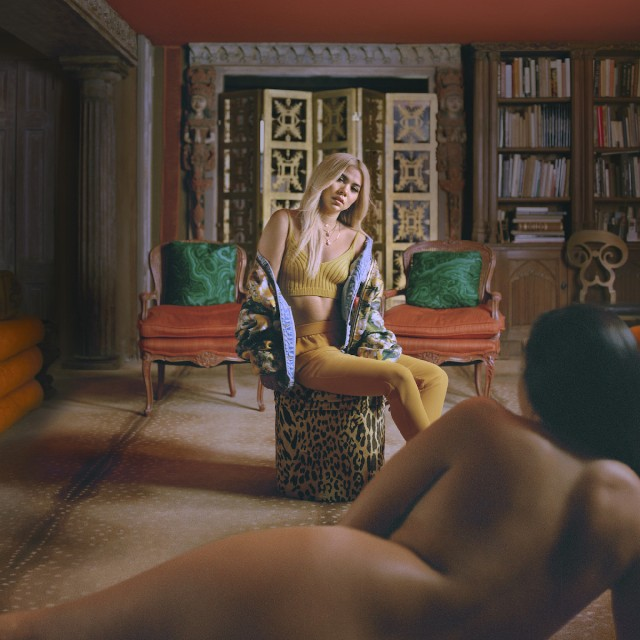
It is significant that Kiyoko’s music centers not only on queerness as an identity, but on the complexities of lesbian desire. This focus on desire, and specifically on the female or the lesbian gaze, is clearly articulated in the album’s cover photo. The cover of Expectations depicts Kiyoko sitting in an ornate room at the center of the frame, gazing at a naked woman lying on the floor in front of her. The woman’s nudity – apart from her back and hip – is not visible to the viewer; only Kiyoko has the full view. In his classic BBC television series Ways of Seeing (1972), John Berger describes the ways in which classical visual art, and in particular portraiture, objectifies women through the enactment of the male gaze, whether it be the artist gazing at his muse, or the viewer gazing at the art. Importantly, the “bearer of the look,” to use Laura Mulvey’s phrase, is rarely seen, and instead the image itself frames the women as an object-to-be-looked at. On the cover of Expectations, Kiyoko takes the position of the “bearer of the look,” and the object of her gaze, a figure who is usually the focus of the image, is partially pushed out of frame. In this way, Kiyoko’s own lesbian desire is centered as she gazes at the woman in front of her. The viewer, however, is unable to access this gaze from her perspective and instead must focus on Kiyoko’s desire itself as the focal point of the image, rather than the woman we are unable to fully see. In this sense, Kiyoko is able to deconstruct the male gaze through her centering of lesbian desire.
By putting herself in a position that would usually be occupied by men, Kiyoko is able to disrupt dominant understandings of male and female desire. As Kiyoko herself puts it, this desire for disruption comes from the experience of growing up in a society that understands desire exclusively through the lens of heterosexuality. “Growing up, I didn’t want to be a guy, but I was envious of the way women looked at men, and I wanted women to look at me that same way.” Kiyoko’s performance of desire is significant in that it contradicts two popular and opposing frameworks of lesbianism: the lesbian as fetishized, and the unsexy, overly emotional lesbian. Kiyoko’s music refuses fetishization because it is her own desire that is centered, and departs from lesbian music of the 1970s in its outright discussion of that desire. In her 2011 article about “Glee’s Shameful Lesbian Musicality,” Christina Belcher discusses the way lesbian music becomes associated with lesbian shame, as lesbian music becomes the symbol of the unsexy, stagnant lesbian. This feeds into what Elizabeth Freeman calls the “lesbian drag,” wherein “the “lesbian” is a temporal figure that pulls the queer, progressive present back toward a degraded, conservative past” (412). While this assumption that lesbian music is unsexy is perhaps unfair, it is an association that has stuck. In this regard, it is crucial that Kiyoko’s Expectations allows us to define lesbian music as something that exists not in the past, but in the present day. Nonetheless, while her music is sexy, both in sound and content, it is also very emotional and personal. (See, in particular, “Feelings”). Thus, it is not that Kiyoko is completely turning away from pre-digital lesbian culture and practice, but rather that she is updating this artistic frame for the present day.
I would be remiss in my duties as the foremost Hayley Kiyoko scholar if I did not also mention the importance of Kiyoko’s music in a performance context. Kiyoko’s Expectations, as it travels from location to location across different formats, manifests the creation of lesbian space. Most obviously, this space is created at her concerts. I attended the Expectations tour when it came to Seattle in April of 2018, and got to experience this unique space – complete with numerous instances of bra-throwing and scores of rainbow flags – for myself. Through Kiyoko’s performance at these venues, and the queer-majority of her audience, these spaces become lesbian or queer spaces (if only for a few hours), a transformation that has a profound effect on those in the audience, myself included. In Gill Valentine’s 1995 article about the music of k.d. lang, she writes “through appropriating the space of the concert venue, her [k.d. lang’s] lesbian audience demonstrates to the few heterosexuals there, how the production of space is dependent on those present” (478). For the few straight people in the audience, this moment creates a strange reversal, where queer people are for once not the ones who feel out of place. Additionally, Kiyoko’s music encourages the creation of lesbian space in less formal environments. As Valentine puts it, “this ability of lang’s music to signify a sense of belonging or imagined community amongst lesbians means that when two women catch each other’s eyes in this way, her music facilitates the fleeting creation of a lesbian space” (480). To put it simply, if a Hayley Kiyoko song plays in the supermarket and two queer women lock eyes, an ephemeral lesbian space is created in that moment. In this way, Kiyoko’s music implicitly queers whichever space it emerges within, providing queer fans with a unique sense of pride and ownership over her music.
While Kiyoko’s music does contain some interesting elements – namely her candid and playful lyrics – Kiyoko as an artist cannot be fully understood from simply a musical perspective. There are many other elements – her visuals, her persona – that contribute to her position within the pop music industry and the passionate fandom that has defined her career. For fans, Kiyoko signals aspirationality through her unmistakable confidence, while also communicating relatability through frequent moments of self-reflection. In her 1998 book Heroic Desire: Lesbian Identity and Cultural Space, Sally Munt writes that the “‘lesbian,’ […] continues to be a powerful strategic sign, an identity – or rather a set of identities – which is responsive and resistant to the nexus of censure which reduces us to an absence” (4). At the heart of it, it is Kiyoko’s lesbian presence, across all facets of her art, that determines the cultural power of her music and the dedication of her fans. Lesbian Jesus, indeed.
In the last decade or so, a peculiar phenomenon has begun to occur in certain corners of the internet. Soap operas, particularly of the Latin American variety, have slowly begun to feature more lesbian couples. There was “PepSi” from Los Hombres del Paco (Antena 3, 2005-2010), “Jemma” from Hand aufs Herz (sixx, 2010-2011), Kate and Rana from Coronation Street (ITV, 1960-), “Clarina” from Em Família (Rede Globo, 2014), “Flozmín” from Las Estrellas (Channel 13, 2017-2018), and most recently, “Juliantina” from Amar a Muerte (Univision, 2018-). Suddenly, it seemed, with the advent of YouTube and Dailymotion, fans from around the world were able to engage with these relationships without having access to the full series themselves. Hundreds of videos of these couples, completely detached (through editing) from the context in which they originally aired, were uploaded to video sharing sites, and an international lesbian soap opera fandom was built. These videos, what Stephanie M. Yeung has called “fugitive representations” (43) because of the ways in which they are queerly archived and consumed, has continued to proliferate on YouTube and on other video sharing platforms, as more queer women discover and become invested in these relationships. The most recent, and arguably the most popular of these couples, is Juliantina.
Screenshot from a Flozmín video on Dailymotion. Source.
Juliantina—a portmanteau of Valentina and Juliana, the two character’s names—is a relationship that exists on the telenovela Amar a Muerte. The series aired both on American Spanish-language network Univision and Mexican network Las Estrellas. Amar a Muerte follows a typically complex telenovela storyline centering on the deaths and reincarnations of Valentina and Juliana’s respective fathers. This central storyline, however, is only peripheral to Juliantina fans, who are focused exclusively on their love story. Most of this content is archived on YouTube. The most popular Juliantina channels have posted between 270 and 336 videos of the couple. These videos are between one and fiveminutes long (though usually closer to one), and span their entire relationship, from their first meeting to the conclusion of the series. Juliantina’s popularity has expanded further than the usual niche existence of these fugitive representations, with several famous lesbianYouTubers posting reaction videos, and popular queer websites, such as Autostraddle posting articles about the couple. The two actresses who portray Juliantina, Macarena Achaga and Bárbara López, even commissioned a special Juliantina photoshoot for their fans. (It is likely that López and Achaga’s enthusiastic engagement with fans has contributed to the overall popularity of the pairing). In addition, because viewers were so enamored with the couple, one fan created a fake Juliantina Netflix movie trailer, and another created and circulated a petition to make a Juliantina spin-off.
Post from Achaga’s Instagram depicting the Juliantina photoshoot. Source.
Juliantina’s popularity and the fan practices that comprise its fandom illustrate several unique factors that are central to the maintenance and production of queer female fandom online. One of the most intriguing aspects of Juliantina, and of all these soap opera lesbians, is the way that most viewers consume this content. As I mentioned above, the videos that are uploaded to YouTube and other social media sites are edited in such a way that the narrative only focuses on the lesbian relationships, while other storylines become peripheral or even nonexistent. Yeung calls this process “queer cutting” and suggests that “these capabilities [online streaming] are also allowing fans to rescue and preserve generative and meaningful lesbian representations whose value is further discounted within an already disparaged form” (44). This process of queer cutting complicates normative understandings of television viewership, as Juliantina fans are only interested in one storyline within the series, rather than the series as a whole. The Juliantina videos are edited in such a way as to include only scenes that involve either Valentina or Juliana (or both), so that viewers can follow the Juliantina storyline in its entirety. Understandably, viewers who only watch the Juliantina videos are often confused about the other narratives within the show (namely the reincarnation storyline), and in this case the comments section acts as a space where fans can ask questions and receive answers from more knowledgeable viewers. YouTube then acts as an archive for this queerly-constructed content, which in turn provides a space for this fandom to coalesce. However, this archive is tenuous, as videos are often flagged for copyright by the networks, which leads to them being blocked in some countries. Fans often combat this problem by making the videos as short as possible or uploading them to Dailymotion, Facebook, or Dropbox instead, where copyright issues are less of a concern.
Fan-made Juliantina Netflix trailer.
In addition to this particular style of editing, every Juliantina video is also translated into English by the Latin American fans who upload these videos. (The identities of these video creators remain unknown to most, as they are often only known by their usernames). This extensive fan labor allows for the existence of an international fandom surrounding these representations, with fans often expressing their gratitude for the video creators in the comments section as they wait for the next batch to be uploaded. (See more on translation in text box). The international reach of this fandom is made visible in the comments sections of these videos, with viewers often revealing their location through comments such as “Thank you Thailand!” or “Watching from Germany!” Though all fandoms are now more international than ever, the international scope of the Juliantina fandom is significant in that it makes visible the labor that is involved in maintaining this fandom. Additionally, the global flow of Juliantina content is unique, as much (though not all) of queer media that is celebrated and viewed globally is American or English-language content. Furthermore, the international popularity of Juliantina and other similar couples indicates the continued lack of affirming portrayals of queer women on a global level, as well as the almost indescribable draw these couples have for fans across borders and across language.
A portion of the comments section from a Juliantina video, with commenters praising YouTube user “All the Lilies” for their translation work. Source.
While soaps and/or telenovelas like Amar a Muerte are often perceived as unrealistic because of their reliance on melodrama, the international popularity of Juliantina with audiences who may not normally watch telenovelas indicates that it is the content rather than the form that draws viewers to the couple. Despite the connotation of soaps as frivolous, many Juliantina fans describe their investment in the couple as predicated upon the perceived “realness” of the relationship. I don’t mean real in the sense of “existing in the non-televisual world,” but rather real for the viewer in the sense of relatability (I have felt/experienced those feelings) or aspirationality (I haven’t experienced that, but I would like to someday). Ien Ang describes this structure of feeling as “emotional realism” (in Storey, 153). It is queer fans’ investment in this emotional realism that produces their enjoyment of these fugitive representations, regardless of the national or generic context in which they exist, and it is sites like YouTube that allow these representations to proliferate on an international level.
Youtube suggestions after I watched Juliantina videos on a guest account. Many of these videos are clips of other lesbian couples from Spanish-language soaps and serials.
Though I have focused this article on Juliantina specifically, as I outlined above, there are a number of soaps from around the world that have engendered similar fan practices. These soaps, and the lesbian relationships therein, are part of what we might call the canon of queer female media. As Yeung (46) points out, YouTube, as the disseminator of much of this content, acts as an archive for this canon, and connects these texts to one another through its algorithmic functions. YouTube’s algorithm, as well as the cultural knowledge of fans, allows for and encourages fans of one pairing to become invested in another, as fans who watch these queer soaps are pointed towards similar content hosted on the platform. These fugitive fan practices illustrate what Susan Driver calls the “queer possibilities of cultural literacy” (13), wherein the meaning of a text is decoded according to its queer resonances rather than its narrative cohesion. This canon is rarely made visible to those outside the queer female community, as this niche content remains only peripheral to the broader public, despite these couples’ centrality among queer viewers.
Screenshot from a Juliantina video on YouTube entitled “Juliana & Valentina #47 (english subtitles)”. Source.
The fan practices that define the Juliantina fandom illustrate the unique ways in which queer female fans create and consume content, engaging with media in a manner that circumvents problems of access. As Kelsey Cameron puts it, the models of fandom that pioneering fan studies scholar Henry Jenkins often engages with, models that center the practices of white men and are generally divorced from identity work, “do not necessarily translate to queer women, who lack both identity reinforcement from mainstream culture, which Jenkins’s subjects constantly receive, and the embodied sexual spaces that many position as key to the cultural lives of gay men” (1.6). Indeed, the global reach of Juliantina and the fan labor and viewing practices that define its fandom demonstrate the continued marginality of queer women on screen, and, subsequently, the lengths fans must go to in order to preserve and centralize these stories.




 Lesbian and Queer Fans: A Master's Thesis