The following video is an audio/visual explanation of one of the concepts I have utilized in this project: the queer canon. This is also an example of “fanvid” or fan video – specifically a “multifandom” video. Read below for a description of the multiple meanings displayed within the video.
This music video illustrates one of the concepts that is essential to a comprehensive understanding of queer female fandom – that of the “queer canon.” This canon encompasses all of the media content – namely television and film – that is popular among queer women who are interested in pop culture. All of this content is thus linked, not by virtue of its form or any generic conventions, but by virtue of the queerness represented within this content. Thus, in order to understand the fandom surrounding one queer media object, one must also consider the other media that has been consumed by queer women previously. Being literate in this “queer canon” allows one to enter into an online community where everyone essentially speaks the same language, a language which is often not understood by those outside the community. Susan Driver calls this the “queer possibilities of cultural literacy” (Driver 13). The canon only reads as a canon by those who are literate in queerness (ie. queer themselves). In essence, these queer media objects are intertextually linked by virtue of their queerness, and this media is the basis of what we may broadly call “queer female fandom.”
The meaning of this music video, like the meaning of these queer media objects, is multivalent. First of all, the song I have chosen, Muna’s “I Know a Place,” is often considered a queer anthem. Muna is a band comprised of all queer members, and the song’s implicit meaning (described as such by the band and by fans) is that of queer acceptance and safety. Thus, the first layer of meaning in the music video is the most obvious: the connection between the lyrics of the song and the clips shown in the video. The connection between the lyrics and the video clips are fairly simple – lyrics about dancing paired with clips of dancing, or lyrics about comfort paired with someone being comforted. These connections can theoretically be understood by any viewer watching the music video, regardless of their familiarity with the media shown in the video or the concept of queer female fandom more broadly.
An understanding of the second meaning of the music video necessitates some familiarity with the queer. The music video can also be read as a representation of the queer canon, ie. as a representation of (some, not all) the content consumed by and popular among queer female fans. Understanding this meaning requires some knowledge of the particular media objects depicted in the video, in order to understand how each clip relates to each series/film as a whole, as well as how each clip represents common themes among queer female content across the media landscape. (In particular, the concept of hurt/comfort, a popular theme in queer fan fiction. This term is fairly explanatory – it involves one character being emotionally or physically hurt, and another comforting them). In addition, many of these clips represent iconic moments within these media texts, and as such the music video may elicit a stronger emotional response from someone who has seen the majority of the media depicted therein. Lastly, some of the characters depicted in the video are not canonically queer, but are read as queer by many fans and thus are still understood as a part of this broader queer canon. These clips are thus only understood as queer because of their placement among other canonically queer characters, or because of their inclusion within the queer canon by queer female fans.
The third meaning of the music video is a combination of the first two meanings – it represents the connection between the lyrics of the song and the concept of queer female fandom. The lyrics themselves may also be understood in two ways. The first relates to the initial meaning I discussed – the lyrics of “I Know a Place” may be read as speaking to the characters in the music video, all of whom are explicitly or implicitly queer and often in need of comfort. Secondly, the “place” in “I Know a Place” may be understood as the space (both online and offline) that is created by communities of queer female fans. Thus, the song may be read as offering comfort to both the queer characters in the video as well as the queer fans watching it. This multivalent meaning would only be fully understood by those conversant in queer female culture and fandom.
As illustrated above, one function of this music video was to explore how different viewers might take different meanings from the video. It serves as a way to consider the concept of queer cultural literacy, and to evaluate the idea of in-group and out-group viewership of queer content. The notion that various audiences might read this video differently illustrates the ways in which queerness means different things and reads differently depending on one’s positionality. In addition, the music video highlights some of the themes that queer women tend to gravitate towards in the media they consume. Most significantly, the video highlights the concept of hurt/comfort, through the lyrics of the song and the clips that were chosen. This concept is central to queer female fandom, and scenes between characters that depict this dynamic are often very popular among fans.
I also worked to highlight the concept of happiness as an aspirational modality. In essence, queer people often gravitate towards examples of queer happiness that give them a model of what a happy queer future might look like (see Muñoz, 2009 Ahmed, 2010). This media often serves as such a model. Lastly, I wanted to highlight in this video the concept of the female gaze. In this context the female gaze is characterized by the act of women looking at other women without the presence of a male perspective. This “queer looking” is a central component of queer media of the past and the present. (See the extending “looking” sequence at the end of Carol (2015)). These concepts, though not always named as such, are important and familiar concepts within the queer canon that structure how fans relate to this content. The music video serves as a means to pull out all of these ideas in an audiovisual form.
Shows/films featured (in order):
The Bold Type (Freeform, 2017-) Supergirl (The CW, 2015-) Buffy The Vampire Slayer (The CW, 1997-2003) Once Upon a Time (ABC, 2011-2018) Rizzoli & Isles (TNT, 2010-2016) Carmilla (YouTube, 2014-2016) Black Mirror (Netflix, 2011-) Xena: Warrior Princess (NBC, 1995-2001) Imagine Me and You (Fox Searchlight, 2006) Coronation Street (ITV, 1960-) Las Estrellas (Channel 13, 2017-2018) Grey’s Anatomy (ABC, 2005-) Amar a Muerte (Univision, 2018-2019) Person of Interest (CBS, 2011-2016) The 100 (The CW, 2014-) Gentleman Jack (HBO, 2019-) Carol (The Weinstein Company, 2015) I Can’t Think Straight (Enlightenment Productions, 2008) Captain Marvel (Marvel Studios, 2019) One Day at a Time (Netflix, 2017-) Pretty Little Liars (2010-2017) Orphan Black (BBC America, 2013-2017) Sense8 (Netflix, 2015-2018) Orange is the New Black (Netflix, 2013-2019) Wynona Earp (Syfy, 2016-) Skins (E4, 2007-2013) Runaways (Hulu, 2017-2019) The L Word (Showtime, 2004-2009) Black Lightning (The CW, 2018-) But I’m a Cheerleader (Cheerleader LLC, 1999)
In the last decade or so, a peculiar phenomenon has begun to occur in certain corners of the internet. Soap operas, particularly of the Latin American variety, have slowly begun to feature more lesbian couples. There was “PepSi” from Los Hombres del Paco (Antena 3, 2005-2010), “Jemma” from Hand aufs Herz (sixx, 2010-2011), Kate and Rana from Coronation Street (ITV, 1960-), “Clarina” from Em Família (Rede Globo, 2014), “Flozmín” from Las Estrellas (Channel 13, 2017-2018), and most recently, “Juliantina” from Amar a Muerte (Univision, 2018-). Suddenly, it seemed, with the advent of YouTube and Dailymotion, fans from around the world were able to engage with these relationships without having access to the full series themselves. Hundreds of videos of these couples, completely detached (through editing) from the context in which they originally aired, were uploaded to video sharing sites, and an international lesbian soap opera fandom was built. These videos, what Stephanie M. Yeung has called “fugitive representations” (43) because of the ways in which they are queerly archived and consumed, has continued to proliferate on YouTube and on other video sharing platforms, as more queer women discover and become invested in these relationships. The most recent, and arguably the most popular of these couples, is Juliantina.
Screenshot from a Flozmín video on Dailymotion. Source.
Juliantina—a portmanteau of Valentina and Juliana, the two character’s names—is a relationship that exists on the telenovela Amar a Muerte. The series aired both on American Spanish-language network Univision and Mexican network Las Estrellas. Amar a Muerte follows a typically complex telenovela storyline centering on the deaths and reincarnations of Valentina and Juliana’s respective fathers. This central storyline, however, is only peripheral to Juliantina fans, who are focused exclusively on their love story. Most of this content is archived on YouTube. The most popular Juliantina channels have posted between 270 and 336 videos of the couple. These videos are between one and fiveminutes long (though usually closer to one), and span their entire relationship, from their first meeting to the conclusion of the series. Juliantina’s popularity has expanded further than the usual niche existence of these fugitive representations, with several famous lesbianYouTubers posting reaction videos, and popular queer websites, such as Autostraddle posting articles about the couple. The two actresses who portray Juliantina, Macarena Achaga and Bárbara López, even commissioned a special Juliantina photoshoot for their fans. (It is likely that López and Achaga’s enthusiastic engagement with fans has contributed to the overall popularity of the pairing). In addition, because viewers were so enamored with the couple, one fan created a fake Juliantina Netflix movie trailer, and another created and circulated a petition to make a Juliantina spin-off.
Post from Achaga’s Instagram depicting the Juliantina photoshoot. Source.
Juliantina’s popularity and the fan practices that comprise its fandom illustrate several unique factors that are central to the maintenance and production of queer female fandom online. One of the most intriguing aspects of Juliantina, and of all these soap opera lesbians, is the way that most viewers consume this content. As I mentioned above, the videos that are uploaded to YouTube and other social media sites are edited in such a way that the narrative only focuses on the lesbian relationships, while other storylines become peripheral or even nonexistent. Yeung calls this process “queer cutting” and suggests that “these capabilities [online streaming] are also allowing fans to rescue and preserve generative and meaningful lesbian representations whose value is further discounted within an already disparaged form” (44). This process of queer cutting complicates normative understandings of television viewership, as Juliantina fans are only interested in one storyline within the series, rather than the series as a whole. The Juliantina videos are edited in such a way as to include only scenes that involve either Valentina or Juliana (or both), so that viewers can follow the Juliantina storyline in its entirety. Understandably, viewers who only watch the Juliantina videos are often confused about the other narratives within the show (namely the reincarnation storyline), and in this case the comments section acts as a space where fans can ask questions and receive answers from more knowledgeable viewers. YouTube then acts as an archive for this queerly-constructed content, which in turn provides a space for this fandom to coalesce. However, this archive is tenuous, as videos are often flagged for copyright by the networks, which leads to them being blocked in some countries. Fans often combat this problem by making the videos as short as possible or uploading them to Dailymotion, Facebook, or Dropbox instead, where copyright issues are less of a concern.
Fan-made Juliantina Netflix trailer.
In addition to this particular style of editing, every Juliantina video is also translated into English by the Latin American fans who upload these videos. (The identities of these video creators remain unknown to most, as they are often only known by their usernames). This extensive fan labor allows for the existence of an international fandom surrounding these representations, with fans often expressing their gratitude for the video creators in the comments section as they wait for the next batch to be uploaded. (See more on translation in text box). The international reach of this fandom is made visible in the comments sections of these videos, with viewers often revealing their location through comments such as “Thank you Thailand!” or “Watching from Germany!” Though all fandoms are now more international than ever, the international scope of the Juliantina fandom is significant in that it makes visible the labor that is involved in maintaining this fandom. Additionally, the global flow of Juliantina content is unique, as much (though not all) of queer media that is celebrated and viewed globally is American or English-language content. Furthermore, the international popularity of Juliantina and other similar couples indicates the continued lack of affirming portrayals of queer women on a global level, as well as the almost indescribable draw these couples have for fans across borders and across language.
A portion of the comments section from a Juliantina video, with commenters praising YouTube user “All the Lilies” for their translation work. Source.
While soaps and/or telenovelas like Amar a Muerte are often perceived as unrealistic because of their reliance on melodrama, the international popularity of Juliantina with audiences who may not normally watch telenovelas indicates that it is the content rather than the form that draws viewers to the couple. Despite the connotation of soaps as frivolous, many Juliantina fans describe their investment in the couple as predicated upon the perceived “realness” of the relationship. I don’t mean real in the sense of “existing in the non-televisual world,” but rather real for the viewer in the sense of relatability (I have felt/experienced those feelings) or aspirationality (I haven’t experienced that, but I would like to someday). Ien Ang describes this structure of feeling as “emotional realism” (in Storey, 153). It is queer fans’ investment in this emotional realism that produces their enjoyment of these fugitive representations, regardless of the national or generic context in which they exist, and it is sites like YouTube that allow these representations to proliferate on an international level.
Youtube suggestions after I watched Juliantina videos on a guest account. Many of these videos are clips of other lesbian couples from Spanish-language soaps and serials.
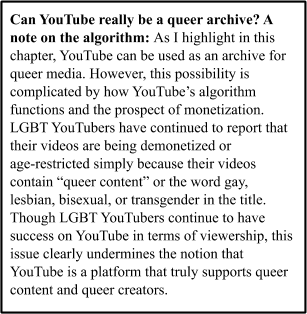
Though I have focused this article on Juliantina specifically, as I outlined above, there are a number of soaps from around the world that have engendered similar fan practices. These soaps, and the lesbian relationships therein, are part of what we might call the canon of queer female media. As Yeung (46) points out, YouTube, as the disseminator of much of this content, acts as an archive for this canon, and connects these texts to one another through its algorithmic functions. YouTube’s algorithm, as well as the cultural knowledge of fans, allows for and encourages fans of one pairing to become invested in another, as fans who watch these queer soaps are pointed towards similar content hosted on the platform. These fugitive fan practices illustrate what Susan Driver calls the “queer possibilities of cultural literacy” (13), wherein the meaning of a text is decoded according to its queer resonances rather than its narrative cohesion. This canon is rarely made visible to those outside the queer female community, as this niche content remains only peripheral to the broader public, despite these couples’ centrality among queer viewers.
Screenshot from a Juliantina video on YouTube entitled “Juliana & Valentina #47 (english subtitles)”. Source.
The fan practices that define the Juliantina fandom illustrate the unique ways in which queer female fans create and consume content, engaging with media in a manner that circumvents problems of access. As Kelsey Cameron puts it, the models of fandom that pioneering fan studies scholar Henry Jenkins often engages with, models that center the practices of white men and are generally divorced from identity work, “do not necessarily translate to queer women, who lack both identity reinforcement from mainstream culture, which Jenkins’s subjects constantly receive, and the embodied sexual spaces that many position as key to the cultural lives of gay men” (1.6). Indeed, the global reach of Juliantina and the fan labor and viewing practices that define its fandom demonstrate the continued marginality of queer women on screen, and, subsequently, the lengths fans must go to in order to preserve and centralize these stories.
“I’m here in 2018. And I feel like crying because I want what they have.”
– YouTube Comments
Note: A version of this chapter was published in an issue of Transformative Works and Cultures. That journal article can be found here.
A lot has changed since the time periods I covered in Chapter 1, both in terms of broader social conventions as well as the media landscape we now live in. Much of this change has gone hand in hand with the rise of the internet and the increasing ease of online communication. For the queer community, the internet has been particularly transformative, as queer people have long used the internet as a tool to manifest digital communities when physical ones are not available. For queer women who were not alive during the rise of lesbian bars, women’s music festivals, and feminist bookstores, online spaces such as Tumblr or YouTube are often essential in the coming out process. In the 2010s – particularly with the increased accessibility of popular media on an international level – pop culture and popular media are often closely intertwined with this process. Popular media can thus become a common language that is shared among queer women across the globe, while also providing queer fans with a sense of wider acceptance and validation. While in the 1950s a lesbian might have begun to explore her sexuality after reading a lesbian pulp novel, in the 21st century the amount of media that queer women may choose to consume during their coming out process has increased significantly. Indeed, queer communities online are often inextricable from fan communities, as many young people discover their sexual identity through fandom, or alternatively, find fandoms as a result of their sexual identity. (See: Susan Driver’s 2007 book Queer Girls and Popular Culture).
As a whole, this project seeks to investigate the spaces that have emerged for queer women as a result of fandom. Chapter 1 discussed the historical precedents of queer culture today, focusing on the physical spaces created by and for lesbians. Chapter 3 will focus on the fan convention ClexaCon as an example of a physical manifestation of the online community building queer female fans have been engaging in for years. This chapter bridges the gap between these two moments by highlighting the digital fan practices of queer women on a potentially international level. (See my bonus piece on “Juliantina” for more on this detail). Here I ask the question: how has YouTube, as well as the content it hosts, created conditions for the emergence of online spaces for queer female fans?I want to consider here how queer female fans have utilized the platform as a means of digital and international community building. Secondly, I ask what are the unique practices that define these spaces and fandoms?Here I will consider the concept of queer cultural literacy and the queer canon, fan labor, and the transmission of emotion in online spaces.
In this chapter, instead of detailing the complete history of queer fandom and queer community online (a nearly impossible task), I am going to focus on one specific platform and an example of the queer fan practices that occur on that platform. (For more on this topic, see Transformative Works and Cultures’ special issue on queer female fandom). I have chosen to look specifically at YouTube because I believe that the queer fan practices that emerge on the platform illustrate some of the unique characteristics of queer female fandom more broadly. These characteristics include this fandom’s intertextual focus as well as its precarious nature, which contributes to the intensity of emotions attached to these media objects. (This intensity is made clearly visible in the examples at the center of this chapter). I have also chosen to focus on YouTube because although there is more and more mainstream content that depicts queer characters, a lot of queer media can still be found outside of mainstream systems of film and television production.
In order to answer the questions I posed above, I will focus on one example of queer female fandom that I think illustrates some of these themes. In the next section, I will discuss two “real-life” lesbian YouTube couples – “Shannon and Cammie” and “Kaelyn and Lucy” – and their eventual breakups, focusing on the pervasive precarity of queer media, the powerful binding effect of grief, and how these videos are used as examples of happy queer futures. This case study will lead to a consideration of what I call the queer canon and the ways in which queer female fans gain a type of “queer cultural literacy” (Driver 13). This cultural literacy allows fans to engage with this media in a way that considers the broader landscape of queer media, a landscape that is generally only visible in its entirety to queer fans. By conducting a discourse analysis of the comments on these YouTube videos, I will be able to gauge the reactions and sentiments of fans and better understand how they define their relationship to these videos and the fandoms surrounding them.
Though the majority of content on YouTube is not queer-oriented, the amount of queer content on the platform is still far greater than in mainstream visual media. The breadth of this queer content is vast and includes vlogs, television clips and episodes, music videos, sketches, comedy videos, and more. The content hosted on YouTube allows queer women to find niche content that caters specifically to their interests, while also providing space for community building through its function as a social media platform. While YouTube is often understood as mainly a video-sharing platform, the comments section of the site, as well as its use on other sites such as Twitter and Tumblr, allow it to function like a social media platform as well. The use of YouTube as a community-building space illustrates the centrality of media objects to queer identity development and indicates a break from a previous era when physical spaces might have served this function. Additionally, the prominence of online spaces in contemporary queer culture also complicates the notion of safe or exclusive spaces that were central to lesbian culture of the 20th century, as these online spaces do not have definable boundaries or rules of entry.
Lesbian YouTube Couples
In May of 2016, while relaxing at my hotel in Southern India, I had the following exchange with my friend Alissa on Facebook Messenger:
The conversation continued as Alissa expressed her disappointment about the breakup, later proclaiming “I’m actually gonna cry.” Shannon and Cammie were a real-life lesbian couple who became popular online around 2014 after they began posting YouTube videos of themselves completing tag videos, answering fan questions, and detailing their life as a couple. They publicly announced their breakup in May of 2016, and their breakup video was uploaded to YouTube on July 1st of the same year.
As my conversation with Alissa illustrates, fans, particularly queer women fans like Alissa and I, were very upset by Shannon and Cammie’s breakup and expressed their feelings in various forms online. The moment of their breakup was significant on its own, but then, two months later, another popular lesbian couple on YouTube announced their breakup. Kaelyn and Lucy, who became popular in 2012 as a long-distance-couple that eventually moved in together, uploaded their breakup video on September 11, 2016. Both of these breakup videos elicited emotional and affective responses from fans, and as I will illustrate, these responses traveled across videos, and across the two YouTube channels. Though queer content of all kinds often evokes intense reactions from queer fans, queer content on YouTube often elicits even more personal investments from queer fans as this content is seen as closer to (if not synonymous with) reality. Indeed, YouTube videos often rely on the concept of intimacy (Raun 2018), as fans often become personally invested in what they see as the true-to-life journeys of YouTubers. Thus, as I will illustrate, it is both the content and the form of these videos that produced such intense responses. The topics I want to keep in mind here are what the reactions of fans to these breakups say about the nature of queer female fandom and YouTube fandom, as well as the importance of YouTube as a space for the archiving of this queer content.
To begin, it is important to understand both the history and the popularity these two couples achieved. Shannon and Cammie posted videos to the channel nowthisisliving, which was originally (and is once again) Shannon’s personal channel. The channel has 673,000 subscribers, and 86 million channel views. (All of the following video statistics are as of December 6, 2019). The first video Shannon and Cammie uploaded as a couple is called “Girlfriend Tag | LGBT” and was uploaded on July 18, 2014. Their breakup video, which was uploaded almost two years later, is the channel’s second most popular video and has 3 million views and 9,353 comments. In total, 97 videos of them as a couple have been uploaded to the channel, amounting to hundreds of hours of footage. Kaelyn and Lucy’s channel is called Kaelyn and Lucy, and their first video, entitled “July 2011”, was uploaded on April 27, 2012. They have uploaded 139 videos on the channel, many of which (like their first video) detail their experiences reuniting after time apart, either in the UK or in America. Their breakup video – uploaded more than four years after their first video – has amassed 1.2 million views and 4,375 comments. (Since these two (in)famous breakup videos, the “lesbian breakup video” has become a video category in and of itself, with popular lesbian YouTubers Rose and Rosie even making a video ranking lesbian breakups on YouTube).
Indeed, these two couples are not the only popular lesbian couples on YouTube; others include Rose and Rosie, Bria and Chrissy, Sam and Alyssa, Paige and Holly, and Kristen and Steph, among others. In addition, solo lesbian YouTubers like Ari Fitz, Amber’s Closet, and Hannah Hart have achieved significant success. As several scholars (Alexander & Losh, 2010, Lovelock 2016, and Wuest, 2014) note, YouTube has also become a prolific space for the production of “coming out” videos, a trend that aligns closely with the focus on authenticity among YouTube creators. Indeed, the centrality of intimacy and authenticity on YouTube, as well as its algorithmic functions (ie. pointing the viewer to related videos) allow these queer cultural forms to proliferate on the site. Lastly, as I note below in regards to the “queer canon,” YouTube has become a useful space for the archiving of fictional lesbian representations. This broader context illustrates why queer female fans might turn to YouTube to find content that fits their needs.
The fandoms surrounding both of these couples have expanded outside of YouTube, as fans have created Twitter, Instagram, and YouTube pages dedicated to the couples. The couples themselves were also active on these social media platforms. Although the expansiveness of these fandoms is significant, I will be focusing specifically on YouTube comments because these responses are the most immediate and the videos themselves are at the center of these fandoms. YouTube comments are able to be read and posted before, during, and after the viewing of the videos themselves, and thus constitute an essential component of YouTube as a social and communicative platform. In addition, I am interested in how YouTube has emerged as an online space for queer women to congregate, as a result of the creative engagements of both queer YouTube creators and fans. In this vein, we may want to assess whether or not the queer enclaves created on YouTube could be considered “safe spaces,” or whether their space on this enormous and often troll-filled platform negates this categorization.
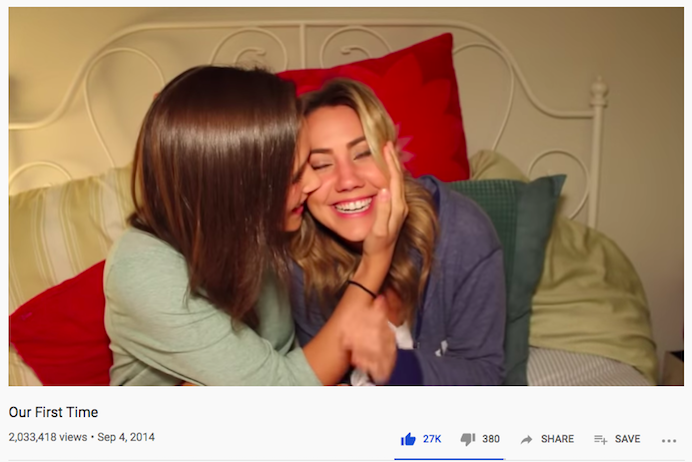
Screenshot from Shannon & Cammie’s (pre-breakup) video, entitled “Our First Time.”
Background
Methods
In order to investigate the questions I have highlighted above, I have performed a discourse analysis of the first 100 comments on six videos – the two breakup videos, as well as two videos from each couple uploaded prior to the breakup. In general, discourse analysis is used to investigate the process of communication, looking at what is said, why it’s said, who says it, and the effects of this language. I use this tool to consider how fans understand their relationship to these videos and the ways in which they communicate with one another as well as with these YouTube creators.
As I analyzed the comments section I focused on the comments that represented a common sentiment among viewers, and I then divided these comments into categories that I will discuss in the next section. Though the first 100 comments that show up below a YouTube video are not wholly representative of every comment posted, the comments that show up first are the ones with the most likes or responses, which indicates that these comments may represent a popular opinion among viewers.
The comments I have pulled out to include in this chapter are those that most clearly or succinctly represent the sentiment I am focusing on. Comments were anonymized to protect the privacy of users who might not want their comments – many of which are of a personal nature – to be published with their names attached. Throughout my analysis, I looked for the ways in which commenters performed and/or transmitted an affective response to these videos, and how that affect traveled throughout the YouTube platform. By this I mean the ways in which affective responses to one video or one couple did not simply “stay put” among a single video or channel, and instead traveled around/across various lesbian-centered content on YouTube. In this context we might think of affect by considering Theresa Brennan’s famous question, “Is there anyone who has not, at least once, walked into a room and “felt the atmosphere?”’ (1). In this sense, to be affected is to feel the passage of emotion or feeling through one’s body. Of course, while YouTube is not a physical space, online environments can still carry the same type of affective charge that physical spaces can.
Affect
There has already been much scholarly work produced about the circulation of affect through online spaces. Jodi Dean’s influential book Blog Theory: Feedback and Capture in the Circuits of Drive, is particularly relevant to this project. Dean wrote that “Blogs, social networks, Twitter, YouTube: they produce and circulate affect as a binding technique” (2010, 95). I argue that it is fans’ affective investment in these couples that made watching their videos pleasurable, and that this investment is also what caused such strong reactions to their breakups. Dean also notes that each blog post, video, or tweet “accrues a tiny affective nugget” (2010, 95).
I will illustrate how the affect that is tied to these couples’ videos changes once the breakups occur. In this vein, I also draw from Sarah Ahmed, who proposes the concept of “happy objects,” i.e. objects that become tied to the promise of happiness. Ahmed writes that “If objects provide a means for making us happy, then in directing ourselves toward this or that object, we are aiming somewhere else: toward a happiness that is presumed to follow” (2010, 26). I contend that these couples’ YouTube videos initially circulated as happy objects, but for long-time viewers, this happiness became detached from the videos once the couples broke up.
Parasocial Relationships
The intense investment that many fans have in these couples is in part because of the supposed intimacy that emerges between YouTube creators and their fans. Horton & Whol (1956) might have defined this bond as what they called a “parasocial relationship,” which is a one-sided relationship one might have with a celebrity or a fictional character, for example. Indeed, Meyrowitz (1994) identified among fans what he called “parasocial breakups,” which have been shown to cause parasocial grief and intense emotional reactions (Sanderson and Cheong, 2010; Eyal and Cohen, 2006; Cohen, 2003, 2004). DeGroot and Leith (2015) illustrate that parasocial breakups can be applied to the deaths of fictional television characters as well. In the case of YouTube couples, this breakup has a double meaning – first there is the “real-life” breakup of the couple, and then the parasocial breakup of the couple and their fans. The supposed intimacy between YouTubers and their fans and this “double breakup” thus affects how fans grieve this particular loss.
At the same time, this focus on intimacy within the YouTube community complicates this notion of the parasocial. Tobias Raun (2018) has written about the ways in which transgender micro-celebrities on YouTube have capitalized on the idea of intimacy in order to create interactive fan communities, which in turn re-configures intimacy as a currency (both social and economic). Raun (2018) argued that “micro-celebrities must signal accessibility, availability, presence, and connectedness – and maybe most importantly authenticity – all of which presuppose and rely on some form of intimacy” (100). This reliance on intimacy at least partially disengages the Youtuber/fan relationship from the concept of the parasocial, as both fans and creators conceptualize this relationship differently than a typical celebrity/fan relationship. Within the YouTube community, sharing personal information with fans is the backbone of the fan/YouTuber relationship, whereas for mainstream celebrities this type of sharing, though appreciated by fans, is not expected in the same fashion. This reliance on intimacy is one of the qualities fans most appreciate about YouTube celebrities, and this intimacy is also a powerful and affective force for queer fans looking for someone to relate or look up to.
Vlogs like these are an example of the intimacy that is often expected on YouTube. This video is part of “vlogmas,” which is a series that some YouTubers do that involves vlogging every day of December until Christmas day. Vlogmas videos often give viewers more access to YouTubers lives, as most YouTubers do not normally vlog every day (or vlog regularly at all).
The Queer Canon and the Archive
Another important aspect of queer female fans’ relationship to these videos is their existence within what I call the “queer canon.” As Stephanie M. Yeung (2014) notes, YouTube has become a productive space for the proliferation of videos depicting lesbian couples on television series across the world. As Yeung puts it, “YouTube, as de facto archive, has become a site for the preservation of and community building around global lesbian representations” (2014, 50). These videos include clips of fictional lesbian couples, as well as real-life queer women posting on their own channels, and they are produced and consumed on an international level. Thus, the videos of these two couples exist not only within the broader YouTube archive, but also within an archive of global lesbian love. I call this archive the queer canon (see this bonus chapter about the concept), and it is fans’ knowledge of this canon that contributes to their reactions to each individual text.
However, it is important to note that this queer canon is not in fact universal. This particular canon of real-life YouTube couples is specifically a white queer canon – both the couples I am focusing on, as well as the other lesbian couples mentioned in the comments, are white and cisgender. While there are queer women of color and queer trans women with significant presences on YouTube, the comments on these videos indicate that these women are often not considered within this canon. Perhaps they exist on the periphery of this canon, or within alternative or subgeneric canons – this particular question is beyond the scope of this chapter. In the future, I would urge readers to continue investigating how other factors like race, gender identity, and ability affect the formation of queer canons.
Lastly, YouTube serves as an archival space where fans can view, re-view, and save these videos. As Abigail De Kosnik argues, “At present, each media commodity becomes, at the instant of its release, an archive to be plundered, an original to be memorized, copied, and manipulated – a starting point or springboard for receiver’s creativity, rather than an end unto itself” (2016, 4). The archive of YouTube allows users to interact with videos on “fan time,” which De Kosnik argues is “spent in repetition rather than in progression” (2016, 159). As Ann Cvetkovich (2003) illustrates, the maintenance of an archive is particularly important for the queer community. Cvetkovich writes about “the profoundly affective power of a useful archive, especially an archive of sexuality and gay and lesbian life, which must preserve and produce not just knowledge but feeling” (2003, 241, emphasis mine). I argue that it is the queer feelings depicted in these videos, namely happiness and romantic love, that make them a powerful and affective archive for queer YouTube users in particular.
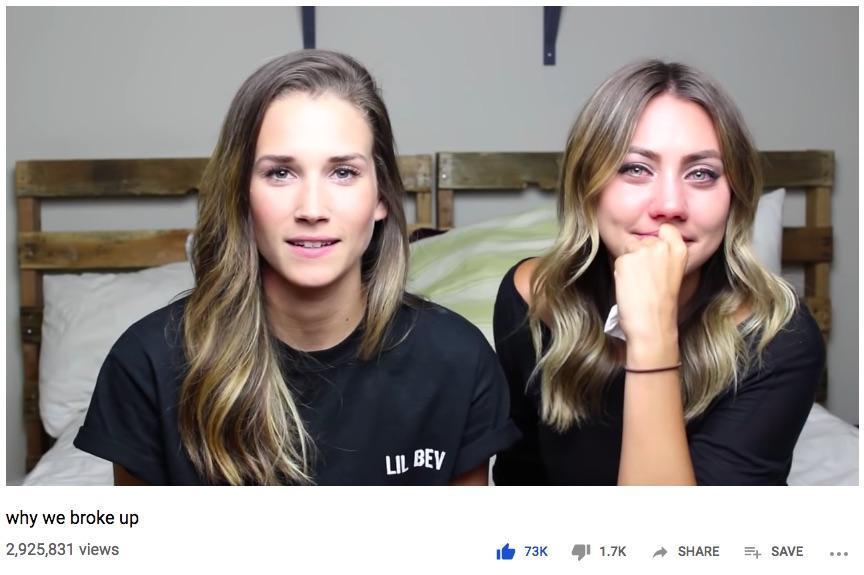
Screenshot from Shannon and Cammie’s breakup video, entitled “why we broke up.”
Pre-Breakup: The Videos as Happy Objects
In order to situate the breakup videos in the context within which they would have been received, I will begin by looking at comments that were posted on the pre-breakup videos while the couples were still together. During this period, the videos of the two couples were still being circulated as happy objects, and were associated with queer love and happiness. I have separated the comments on these videos into two main categories: comments that focus on how “cute” the couples are, and comments that describe how inspirational the videos are. Here are some examples of comments in the first category.
Category 1: “Cuteness”
Comments like these often contain exclamation points, emojis, or all-caps, indicating an overwhelming investment in the “cuteness” of these couples. For many viewers, this investment in “cuteness” is aspirational, as whatever warm feelings these videos may produce in viewers may also be connected to a sense of longing for this queer “cuteness” in their own lives. As two of these comments suggest, fans would also rewatch these videos when they needed their “cute lesbian couple fix.” While comments exclaiming about the “cuteness” of couples are common across the broader genre of YouTube couples, the aforementioned “cute lesbian fix” comment indicates that these affective responses are reactions to not only their status as couples in love, but also as lesbian couples in love. The second category, which I will discuss below, also supports this conjecture that many fans are responding specifically to the images of lesbian love that these couples represent. Though I cannot decisively know the sexual identity of these commenters, the number of comments that focus on these couples’ lesbian identities indicates that a large number of commenters identify as lesbian, bisexual, or queer themselves.
Category 2: “Inspiration”
Comments in the second category, which describe the ways in which the videos have inspired the commenters, indicate the importance of identity in these videos more clearly. What follows are some examples from the second category of comments.
The main emphasis of these types of comments is either that the videos have inspired the commenter to come out or further accept their own sexuality, or that the videos give the commenter hope that they will someday find the happiness that these couples have.
This sense of futurity is important to the circulation of these pre-breakup videos as happy objects. Here I turn to Julie Wilson and Emily Chivers Yochim, who use Ahmed’s concept of happy objects to discuss the “pinning” practices of moms on Pinterest. They contend that “the practice of pinning happiness is posting and sharing content that points toward the possibility of happiness” (Wilson & Chivers 2015, 234). The videos of these lesbian couples may serve as these future-oriented happy objects for queer fans who may not see happy queer couples in their daily lives. Fans may orient themselves towards these objects as a form of identification, as identification itself often points towards the future. As Ahmed puts it, “identification is the desire to take a place where one is not yet. As such, identification expands the space of the subject: it is a form of love that tells the subject what it could become in the intensity of its direction towards another (love as ‘towardness’)” (2004, 126). For lesbian and bisexual viewers, investment in these videos as happy objects may provide ontological security in a world saturated with precarity, particularly for LGBTQ people (see Butler, 2004). This precarity is underscored by the continued physical and/or emotional violence many LGBTQ people face, as well as the limited examples of queer happiness (romantic or otherwise) that are available to young queer people looking for models of queer stability. Taken together, the comments under these videos indicate the affective investment viewers have in these couples, and likely contributed to the intensity of reactions to the breakups that followed.
Post-Breakup: Grief, Loss, and Anger
On May 11, 2016, Cammie Scott tweeted the following: “Shannon and I are no longer together. I love you guys endlessly but please understand we have to do what’s best for ourselves right now ❤”. On July 1, 2016, the much-awaited breakup video, entitled “why we broke up”, was uploaded to the nowthisisliving channel. On September 11, 2016, after almost three months with no uploads, Kaelyn and Lucy uploaded their breakup video, entitled “The End”. Both of these videos, and the breakups of these two couples, elicited strong emotional responses from fans. For some fans, the close temporal proximity between these two breakups compounded the emotional devastation that they experienced. In addition, on May 18, 2016, it was officially confirmed (by Stevie, on Twitter) that another popular lesbian YouTube couple, Ally Hills and Stevie Boebi, had broken up. They never made a breakup video, as they did not run a joint channel, so I will not be discussing their breakup in detail here. However, it is important to note that at least some queer women fans would have had knowledge of all three of these couples. I will now turn to the responses viewers had to these breakups.
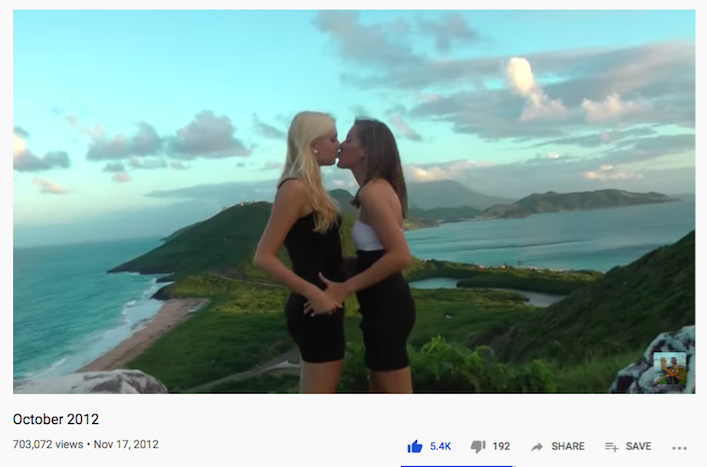
Screenshot from Kaelyn & Lucy’s (pre-breakup) video, entitled “October 2012.”
In her book Post-Object Fandom, Rebecca Williams wrote writes that “a fan pure relationship may only be sustained while it offers ontological security and a sense of trust in the other party” (2015, 26). Put simply, ontological security is the maintenance of a coherent framework or narrative of the self within an environment saturated by doubt and uncertainty. Williams argues that when this fan pure relationship ends due to the loss of a fan object, the fan goes through a period of mourning wherein they must face this loss of ontological security. This is the period where what Williams calls the “post-object fandom” begins. She describes three possible responses a fan may exhibit in response to this loss: a reiteration discourse, a rejection discourse, or a renegotiation discourse. For my purposes, I will focus on the first two responses. The reiteration discourse involves a reiteration of the fans’ self-reflexive and identify-affirming relationship to the text, while the rejection discourse occurs “when the ending of fan objects is perceived as violating the sense of ontological security that has previously been negotiated via fandom” (Williams 2015, 103). The renegotiation discourse – which is exemplified by fans who have a more moderate reaction to these endings and are able to “move on” – is not applicable in this case because fans who had this response were presumably less likely to comment on the videos. (I found very few comments that fit within this categorization). Instead, I have posited a fourth response (The Queer Canon response) viewers have to these videos, which involves viewers highlighting the intertextuality of their viewing practices on YouTube through an engagement with the (white) queer canon.
Category 3: “The Reiteration Discourse”
First, I will provide examples of fans who exemplify the reiteration discourse. In their comments, these fans highlight how these videos have had a positive effect on their lives and thank the couples for the services they have provided fans.
Though comments like these were present on both the breakup videos, they were the least common type of response I found. The following comments, which represent the rejection discourse, were much more common. These comments include some type of speculation about the breakup, often containing suggestions that one individual within the couple is primarily responsible for the breakup, or judgments about how quickly one or both of the women have “moved on”.
Category 4: “The Rejection Discourse”
For many of these commenters, their response to the rupture in ontological security that these videos triggered was to lash out at the couples (or one individual within the couple) in order to rationalize this loss. The large number of these types of responses, as well as the high number of likes that many of these responses garnered, indicates that these sentiments were shared by many fans. These responses illustrate how fans themselves had a personal and emotional stake in these relationships and felt they had knowledge of their inner workings. Responses such as these illustrate the ways in which YouTube acts as a liminal space that blurs the lines between fiction and reality. While many commenters seem to view these videos as the unfiltered truth, most YouTube users are also aware of the editing process that these videos undergo. In addition, fan comments like these resist the categorization of these relationships as parasocial, as many fans feel close to these YouTubers, and the YouTubers themselves often claim that they feel the same way.
Category 5: “The Queer Canon Response”
The last type of response that was prominent in the comments section were comments highlighting the context of these breakups as they relate to other lesbian couples on YouTube. I call this the “queer canon response,” and I argue that this response arises among viewers who are familiar with the canon of (white) queer female YouTubers, and the canon of queer female media content more broadly. Knowledge of this canon gives each relationship more meaning, as these “in-the-know” fans are aware of previous lesbian breakups, and the general precarity of queer female representations as evidenced by the Bury Your Gays trope. Most of the comments that fall into this category appeared on Kaelyn and Lucy’s video, as their video was released after Shannon and Cammie’s, but some viewers made similar comments about Shannon and Cammie as it related to Stevie and Ally’s breakup.
As these comments suggest, the temporal proximity between these breakups created an anxiety within the broader lesbian YouTube fandom. Many commenters mention two other popular lesbian YouTube couples, Rose and Rosie and Bria and Chrissy, both of whom are married couples and have between 800,000 and 900,000 subscribers. These lesbian YouTubers are thus part of the (white) queer canon on YouTube, related to one another by virtue of their sexual orientation and the subsequent queer or lesbian content they produce. These comments highlight the intertextual viewing practices of queer women who watch YouTube, illustrating what Susan Driver calls the “queer possibilities of cultural literacy” (2007, 13). These comments also demonstrate the ways in which queer fan viewing practices are always underscored with precarity, causing some fans to hold on to these happy objects even more forcefully.
The Videos as an “Archive of Feelings”
As mentioned above, the continued accessibility of these videos is a significant aspect of this post-object fandom. Shannon and Cammie’s videos are still available, even though Shannon now makes solo videos on nowthisisliving and Cammie has started her own channel. Kaelyn and Lucy’s videos are still available even though their channel is no longer active. Lucy comments on the decision to keep the videos online in the breakup video, noting that “the videos on this channel for now are gonna remain public because they touched so many people”. These videos then remain as an archive for fans to revisit whenever they so choose, or alternatively, as content for new fans to discover. However, instead of continuing to circulate online as happy objects, for many fans these videos took on a different association after the breakups. Instead of being associated with happiness and queer futurity, these videos instead became objects of melancholia, as fans revisit old videos that have taken on new connotations.
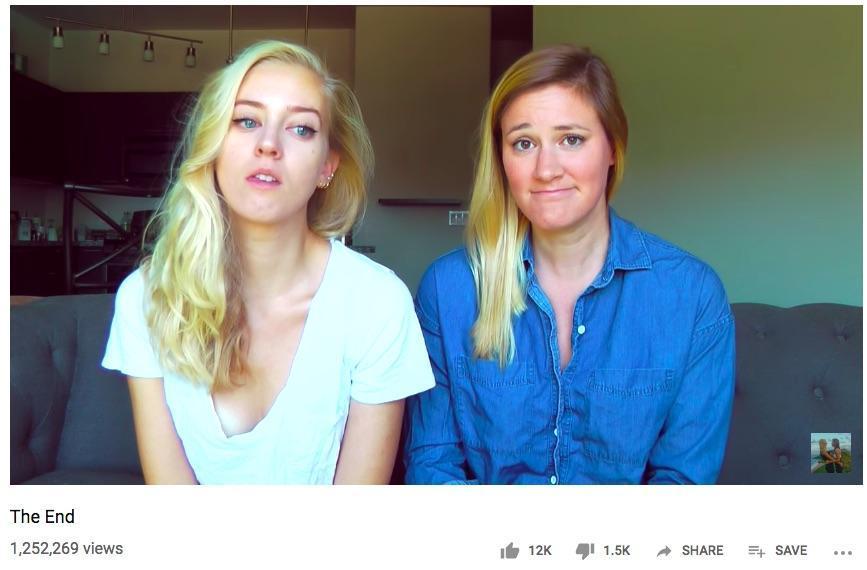
Screenshot from Kaelyn & Lucy’s breakup video, entitled “The End.”
In order to illustrate this phenomenon, I have gone back to pre-breakup videos and looked at comments that were posted after the breakups were made public. The vast majority of these comments express some type of grief. Some of the comments were posted shortly after the breakup videos were uploaded, and others were posted up to two years after the breakups.
While these videos were at the time of their upload date “happy” videos for most fans, for these commenters this happiness is now tinged with grief. There may also be a sense of catharsis present in these responses, as fans go back to watch these videos knowing it will upset them perhaps as a way to productively let go of these feelings. This re-watching, prompted either by the YouTube algorithm or fans’ own desires to revisit these videos, indicates that the process of grieving for these relationships is not always linear, and may come and go in waves depending on new feelings or new content that may arise after the fact. Similar comments appear under the breakup videos themselves, with viewers coming back to watch the videos months or years later, even though they know it’s “torture” to do so.
These comments indicate that for some fans, there is an almost insurmountable urge to re-watch these videos, despite the fact that fans know it will hurt them to do so. This cycle is then cemented as a practice as viewers may scroll down and read about how other fans are engaging in the same re-watching.
The above comments suggest that for some viewers, re-watching these videos constitutes a cycle of melancholia, which as Freud suggested, is a rejection of the “proper” form of mourning, which involves a gradual letting go of the lost object. Instead of accepting that these objects are lost, some fans continue to revisit the site of this loss. Some scholars, such as Muñoz (1999) and Ahmed (2004), have attempted to theorize melancholia in a new light. Both scholars suggest that melancholia can be understood as a queer refusal; a persistent dedication to what has been lost. The viewing practices of these fans illustrate not only the devotion of queer fans to these queer objects, but also how they engage with people and objects in ways that may be difficult to understand for those outside these communities. These re-watching practices indicate a refusal to accept the loss of a fan object, and exemplify the process of keeping the object alive despite its unavoidable “death”. While for most fans, these videos are no longer happy objects, the videos clearly still have use for fans as objects of mourning. The changing meaning of these videos indicate that archives are not fixed entities, but instead, their meanings change as the conditions surrounding them evolve. These online archives are “living”, as comments accumulate and meaning transforms from context to context, and from person to person. Indeed, the preservation of feelings is very important to queer female fandom, as the communal and emotional experience of viewing this media is essential to the experience of fandom.
These lesbian-centered, affective fan/object relationships reveal the complex nature of queer viewership in online contexts. The pockets of affect that circulate through and across lesbian videos on multiple channels illustrate the intertextuality and communal nature of queer female viewing practices, complicating frameworks of what constitutes a fandom or a coherent fan object. This intertextuality is defined by the existence of what I call the (in this case, white) queer canon, which is comprised of texts related to one another by virtue of their queer content. In the future, we –as queer people, scholars, or fans – need to work to address the ways in which factors like race, gender expression, and ability affect the formation of this queer canon and the media we choose to consume. (Indeed, many of the most popular queer female media texts are centered around whiteness and femininity). In addition, although this queer archive on YouTube is tenuous (as I highlight in the text box above), when this content is available to queer female fans it provides them with a sense of security in their own identity – a sense of security that for many, is few and far between. These characteristics of this fandom make these pockets of YouTube feel like spaces of community, affirmation, and safety for some fans, and in many ways, these feelings are reflected in other spaces across the broader queer female cyberspace.
In this vein, we might consider how the queer female side of YouTube interacts with the concept of safety. Social media, and online spaces in general, are famous for attracting trolls, and other forms of mean-spirited interactions. Can we then consider queer communities online safe spaces? The first problem with this conception is that queer pockets of the internet like the fandom surrounding these YouTube couples have no defined boundaries, and it is difficult to visualize the borders of these spaces. Nonetheless, because YouTube and social media have become segmented (ie. users only see a very narrow and incomplete view of the broader media landscape), one’s experience with these platforms becomes very individualized, and users from different communities and with different interests may see entirely different content on their respective feeds.
The second issue with conceptualizing these online communities as safe spaces is the prevalence of trolls. However, in my own research, this was less of an issue that I would have imagined, perhaps because of the niche-ified nature of social media that I just described. I found no comments (out of the 100 I reviewed on each video) that might be classified as homophobic. This might be because fans (or the YouTubers themselves) have thumbs-downed or reported these types of comments, or because “haters” would not have encountered these videos in their feeds to begin with. Whatever the reason, the community that has formed around these videos has created what we might call a safe(er) space, where this archive of queer feelings exists for fans to return to again and again – whether to mourn or to commemorate – with little fear of judgment.
Conclusion
This example of queer female fandom on YouTube reveals the unique nature of queer viewership and queer fandom in online contexts. The pockets of affect that circulate through and across lesbian videos on multiple channels illustrate the intertextuality and communal nature of queer female viewing practices, complicating how we might define what constitutes a distinct fandom or a distinct fan object. This intertextuality is defined by the existence of what I call the queer canon, which is comprised of texts related to one another only by virtue of their queer content. We must however continue to consider how factors like race, gender identity, and ability contribute to what media gets included within this canon.
I chose this particular YouTube fandom in part because I believe it illustrates the extremely personal investment that many queer female fans have in the media they choose to consume. This investment is not entirely different from the personal investments of fans more broadly, except that for queer fans, these visions of queer happiness they find on YouTube may not be visible anywhere else. Queer media across the board often has the profound effect of providing fans with a sense of ontological security, and when this media “dies” – whether it be the breakups of lesbian couples on YouTube or the death of fictional queer characters like Lexa on The 100 (The CW, 2014-) – queer fans have what might otherwise be described as an extreme reaction.
When the media in question involves “real” people, like on YouTube, reactions to these endings hit particularly close to home. In the end, despite the aforementioned issues with the monetization of queer content, YouTube – as well as other sites like Dailymotion, Twitter, and Tumblr – serve as an archive of queer feeling, a mode of being that is at the very heart of queer female fandom. The ability of these online spaces to preserve and transmit these feelings is what make them suitable platforms for the formation of queer female fandom, and is also what differentiates queer female community of today from that of the past.
Indeed, there are many differences between the way queer communities form today and the way they formed in the 20th century, but there are also some similarities. Among queer women of all generations, the concept of cultural literacy is significant. While today queer women might illustrate their queer cultural literacy by displaying an encyclopedic knowledge of The L Word (Showtime, 2004-2009) or Hayley Kiyoko’s music videos, in the past lesbians might have found community because of their interest in lesbian pulp novels or the music of k.d. Lang. In addition, for queer women across generations, the importance of experiencing emotions as a group is central to community building. For young queer women today, this emotional connection occurs primarily in online spaces like YouTube and Tumblr, whereas for lesbians in the 1970s this might have occurred at a women’s music festival or at a feminist literary event. Although the differences between generations at times seem vast, I hope that highlighting these connections – the centrality of media, whether it be mainstream or alternative, in making connections and building community – will allow us to begin to bridge this gap.
Nonetheless, there are also several significant differences between queer female community of today and of the 20th century. Most obviously, the concept of lesbian and queer female space has changed drastically over the last couple of decades. In the 20th century, and in particular prior to the widespread use of the internet, one’s physical location defined their access to queer community.
As I noted in Chapter 1, some lesbians would travel long distances to find queer community, whether it be Greenwich Village, a women’s music festival, or a feminist bookstore. While some queer women still travel to find community (as I will illustrate in Chapter 3), it is now much easier and more common to find queer community online, as most queer fandom exists on an international level. Because of this, queer communities have become more niche, as queer women now have the ability to bond with one another over their shared sexual orientation and similar media taste, whereas in the past lesbians might have found camaraderie simply because of the first characteristic. In addition, the nature of lesbian and queer (safe) space has become more niche and less institutionalized, as long-standing lesbian spaces (see Chapter 1) such as lesbian bars and women’s music festivals have greatly diminished in numbers (though not disappeared entirely). These spaces now primarily exist online, with the exception of specific events like ClexaCon, or concerts put on by queer women, such as Hayley Kiyoko or King Princess.
With this chapter I intended to illustrate the distinct fan practices of queer women, as well as the ways in which queer spaces emerge within non-queer spaces, apart from the mainstream, and often unnamed as such. In looking at the case study of lesbian couples on YouTube, I highlighted the importance of affect, emotion and grief in creating a binding effect among fans. All of this occurred in online spaces, although as I will illustrate in Chapter 3, the intensity of emotions transmitted in these online spaces at times spills out into the “real world.” Indeed, the fan convention ClexaCon, which serves as the focus of Chapter 3, was created as a response to the death of a fictional lesbian character (Lexa from The 100, one-half of the “Clexa” relationship), and as a space for queer female fans to gather and discuss their shared interests. This chapter serves as a bridge between Chapters 1 and 3, outlining the genealogy of queer female community and fandom as it moves from physical spaces, to online spaces, and back to physical spaces once again. By defining and exploring this queer lineage, I hope to illustrate the creative ways in which queer women have engaged with mainstream and alternative media, fandom, and space over time.








 Lesbian and Queer Fans: A Master's Thesis